


Was it Ever Single Origin?
The answer is yes, though not for romantic reasons. “Uji matcha” was once a genuine single-origin product, and it was single-origin because it was illegal for it not to be.
The story begins not in Uji, but in Toganoo, a cluster of hills northwest of Kyoto. For roughly two centuries after the monk Eisai brought tea seeds from China in 1191, the finest tea in Japan came from Toganoo, where the Kegon priest Myoe planted seeds at Kosanji temple. Toganoo tea earned the label honcha, “real tea,” while everything else was dismissed as hicha, “non-tea.” [1] This wasn’t a distinction of processing method or flavor profile. It was a status claim: you were either drinking the real thing from the right mountain, or you were drinking everything else.
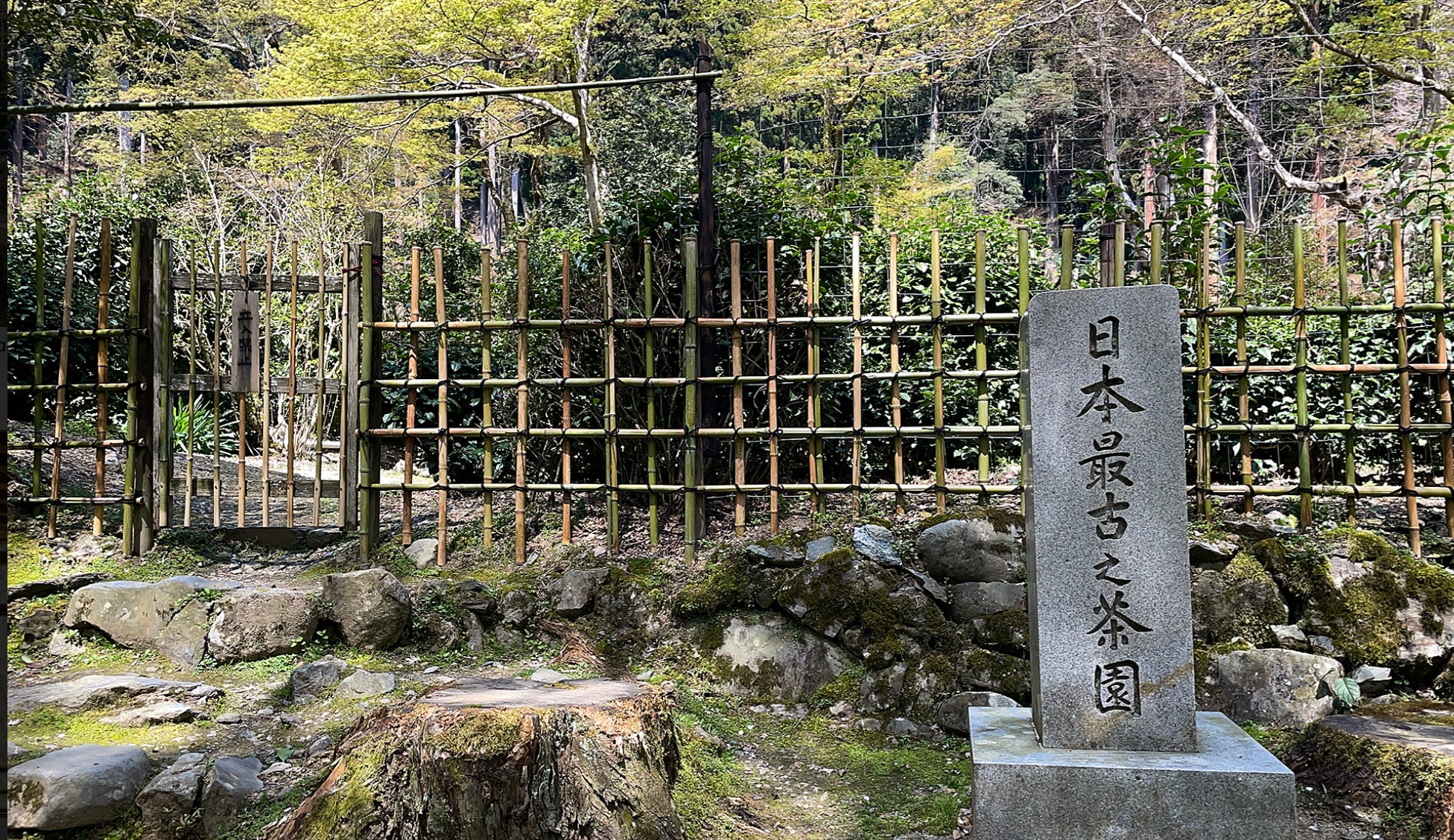
Historian Robert Hellyer notes that Toganoo’s advantage had a surprisingly practical explanation: the temple sits deep in mountain recesses, and a natural canopy of trees shelters the fields, blocking sunlight and reducing photosynthesis. [2] In other words, Toganoo’s microclimate was doing exactly what artificial shading would later do on purpose: preserving the amino acids that give tea its sweetness. What was attributed to the mystique of place was actually an accident of shade. And it was this technique, the deliberate use of shading, that Uji’s farmers would learn to replicate and perfect, at first by accident by putting canopies over fields in spring to prevent frost from forming on new buds, and then with great intention.
By the early fifteenth century, Uji had replaced Toganoo as the premier tea region. How it did so tells you everything about what “Uji” has always really meant. The third Ashikaga shogun and the most powerful man in Japan at the time, Yoshimitsu (1358-1408) and constructor of the Kinkaku-ji complex (the Golden Pavillion in Kyoto), is said to have ordered his commanders to open seven tea gardens along the banks of the Uji River, and to curb overproduction, granted the tea masters various privileges in exchange for a ban on outside sales. [1, 3] This wasn’t organic market success. It was state-directed agricultural development. The Uji brand, as economist Teramoto Yasuhide writes plainly, “was created in the Muromachi era” and “developed constantly under the protection of governmental officials.” [3]
The protection became explicit under Japan’s unifiers. Toyotomi Hideyoshi issued a vermillion seal (shu-injo) prohibiting anyone outside Uji from selling tea under the Uji name. [4] Louise Cort, the Smithsonian ceramics curator, put it memorably: “Hideyoshi conquered Kyoto with tea just as surely as Nobunaga did with fire and the sword.” [1] For the unifiers, tea was not a beverage. It was a political instrument. Nobunaga granted the right to hold formal tea ceremonies as a reward for military service. Both men used tea masters as diplomatic envoys and political brokers. [1]
Under the Tokugawa shogunate, this political protection was formalized into the Ocha-shi San-Nakanoma (御茶師三仲ヶ間), a system of three hierarchical guilds of tea masters who held a state-enforced monopoly. [1, 2] Documents from the Uji City Historical Museum preserve the complete roster: two heads (Ochagashira), both from the Kanbayashi family (a name that still carries weight in Uji today, with more than one Kanbayashi brand competing for the legacy); eleven Gomotsu-rank masters; ten Gobukuro-rank; and eleven Gotsuu-rank. [5] The Kanbayashi family simultaneously held the position of Uji daikan (magistrate), merging political authority with production control. These families enjoyed special privileges: tax incentives, the right to carry swords, and a direct supply chain to the shogun himself.
The guild restrictions governed shaded cultivation, the technique that defines matcha. Other regions could grow tea, and many did. But producing shade-grown tencha under the authority of this system was reserved for Uji. The monopoly was enforced with surprising rigor: all new tea shipments from Uji were banned until the shogun’s own tea jars had departed the city. [4]
And the terroir that made Uji famous? It was deliberately manufactured through fertilizer selection. This is a point that deserves more attention than it usually gets, because fertilizer is one of the single most important variables in determining the final flavor profile of matcha. It was true in the Edo period and it remains true today.
In a 2012 paper and talk titled “How Green Was My Night Soil,” Harvard historian David Howell documented the excremental economy of Edo-period Japan. [6] “Night soil” is the polite term for what this actually was: human excrement, collected from urban households and sold to farmers as fertilizer. And it was not all valued equally. Howell found that Uji tea farmers in the 1830s insisted on sourcing their night soil from only two streets in the Kamigyo (上京) district of Kyoto, the aristocratic quarter where the imperial court and the residences of the kuge (court nobility) were concentrated. The reason was simple: wealthier households had protein-rich diets, particularly from fish, and diets rich in protein produce feces with significantly higher nitrogen content. Nitrogen is the key nutrient for promoting the amino acid production that gives matcha its characteristic umami.
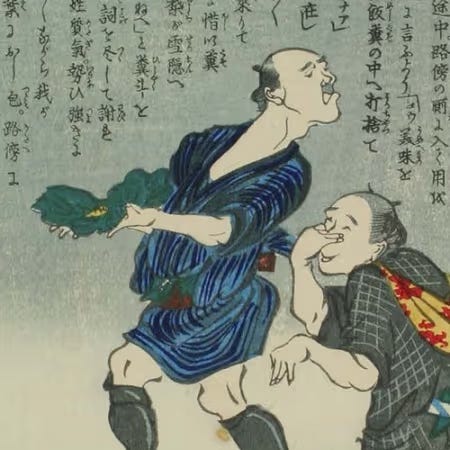
There’s something remarkable about this system, especially because the science wasn’t understood at the time. Fish was a dietary staple for wealthy Kyoto households, and fish-based fertilizers were also widely used in Japanese agriculture. But applying fish directly to soil introduces a problem: salt. The beauty of routing fish protein through human digestion is that the human kidneys filter out the salt, excreting it through urine and sweat. What remains in the feces is nitrogen-rich organic matter without the soil-damaging salinity that direct fish fertilizer would bring. Uji’s farmers weren’t just recycling waste. They were, in effect, running a biological desalination process that optimized their soil for tea production. Talk about a circular food economy!
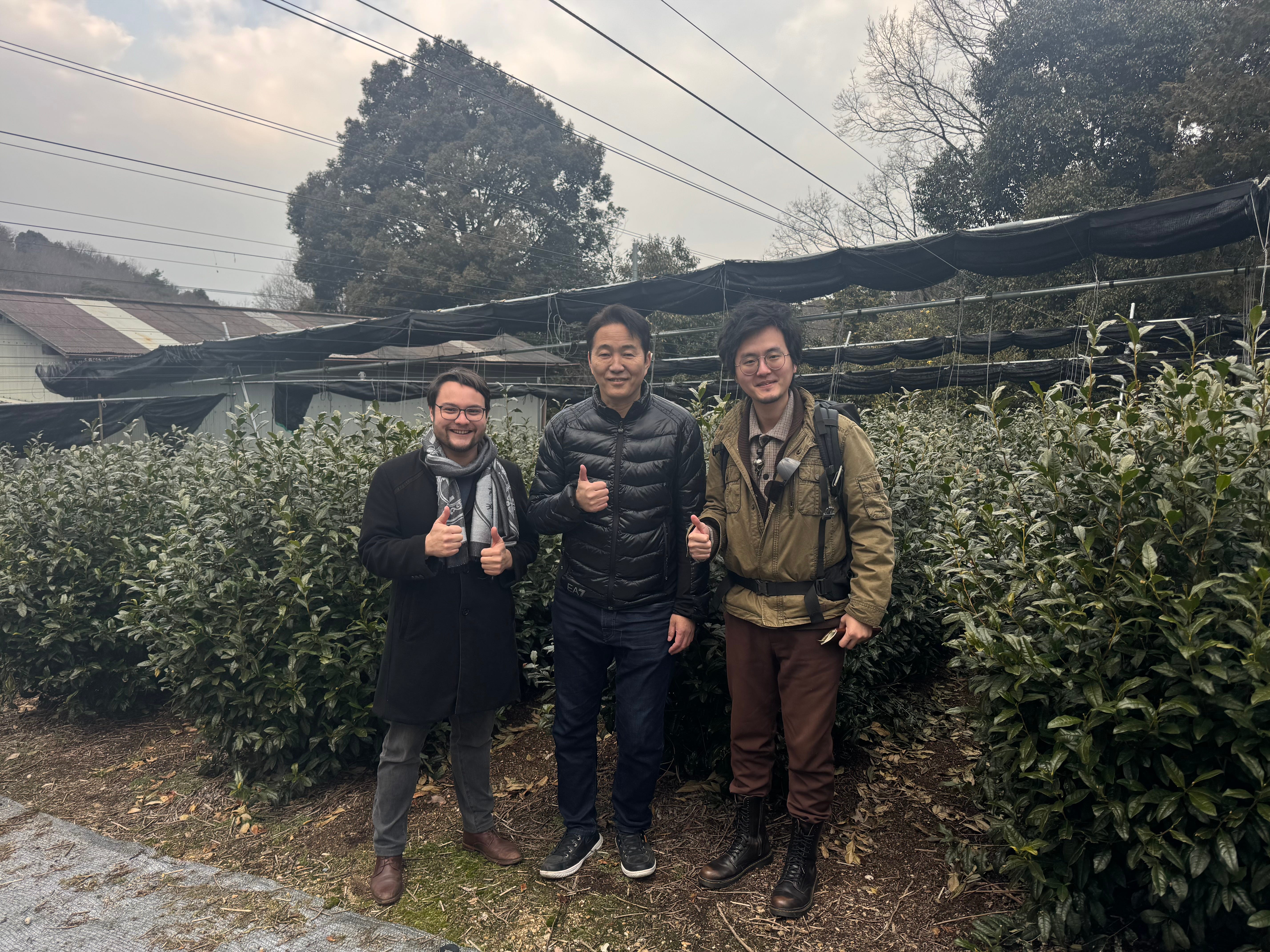
The obsession with fertilizer management in Uji tea families is not a historical curiosity. It persists to this day. Kiyoharu Tsuji of Seicha Tsujiki in Uji Shirakawa is frequently cited as one of the most awarded tencha producers in Japan, with accolades including a Prime Minister’s Award and six Minister of Agriculture awards. [7] As Zongjun and I learned and documented on the Specialty Matcha Podcast after meeting Tsuji-san for the first time, the art and science of fertilizer application in his fields is beyond meticulous. [8] He weighs the pros and cons of variables most people would never consider: how clay versus sandy soil types affect fertilizer absorption, how ambient temperature and rainfall alter nutrient uptake, the accumulation of gas created by rapeseed oil cake-based fertilizer damaging root structure, salt residues left by different types of fish meal, and even the power of glutamic acid-rich fermenting sugarcane byproduct.
This matters because arguably the single most important flavor attribute that determines matcha quality is umami. And where does umami come from? Amino acids, particularly L-theanine, produced in the plant from nitrogen-rich soil. Shading amplifies the effect by artificially inhibiting the biochemical pathways that would otherwise convert those sweet, savory amino acids into bitter and astringent catechins. The entire system, fertilizer and shade together, is an exercise in human intervention. The flavor profile we now attribute to “Uji terroir” was never really about the dirt. It was always about what people put into it.
The supply chain was no casual affair either. For over two centuries, from 1632 to 1866, the Ochatsubo Douchu (御茶壺道中), a procession with samurai guards, carried Uji tea from Kyoto to the Tokugawa court in Edo (modern day Tokyo). [4, 5] It held authority equivalent to the highest aristocratic and religious institutions, second only to the imperial family itself. Even the lords of the Tokugawa Gosanke, the three most privileged branch families of the shogunate, were required to exit their palanquins and have their vassals dismount when the tea jars passed. Roads along the route were repaired in advance. Funerals, farming, and even flying kites were banned.
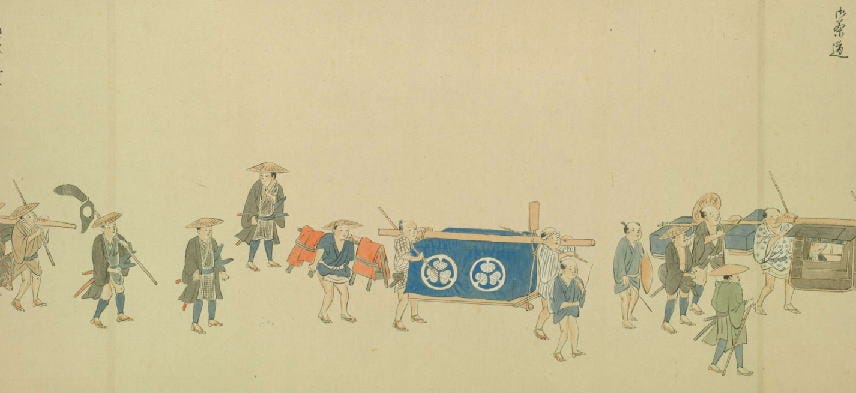
In 1867, the final year of the shogunate, tea was still sent from Uji to Edo, but for the first time without the procession. The Tokugawa government was in its death throes; Shogun Yoshinobu would resign that November. The ritual that had projected the state’s authority through tea for over two centuries simply had no state left to project it. By 1868, the Meiji Restoration dissolved the feudal system entirely, and the Ochatsubo Dochu passed into history.
So What Happened?
What happened was near-extinction, followed by reinvention.
The Meiji Restoration (1868) dissolved the feudal system and the guild protections that came with it. Many tea companies went bankrupt without their direct benefactors. The clientele for matcha vanished overnight: the shogun, the daimyo, the imperial court nobles who had sustained the trade for centuries. Matcha production, which had never exceeded about 40 tons annually under the guild system, collapsed to just 4 tons in 1872. [15]
But the collapse wasn’t total. By 1884, powdered tea production had recovered to 48 tons, and the reason tells a familiar story [2]. The Meiji era produced a new class of wealthy industrialists, the kindai sukisha (近代数寄者), “modern cultural devotees,” who turned to tea ceremony for the same reason Hideyoshi had: to legitimize their power. Men like Masuda Takashi, president of Mitsui & Co. and later known by the tea name Donno, became some of the most influential patrons of chanoyu. As sociologist Kristin Surak argues in Making Tea, Making Japan, tea developed in tandem with shifting contours of power politics. The industrial magnates of Meiji Japan took up tea ceremony much as the warlords before them had, as a vehicle for cultural legitimacy, and in doing so, kept matcha alive. [9]
But the more consequential shift wasn’t at the top of society. It was in the schools. Prior to Meiji, women held relatively marginal roles in tea ceremony. The official Urasenke-approved narrative is that women had no participation at all until Gengensai, the 11th-generation iemoto (hereditary Grand Master) of the Urasenke school, “liberated” women by allowing them to study tea. However, as tea scholar Rebecca Corbett argues in Cultivating Femininity: Women and Tea Culture in Edo and Meiji Japan, the reality of women’s participation in chanoyu was far more complex before Meiji, and the orthodox narrative reinforces patriarchal assumptions by retrospectively bestowing credit onto a “great man” of chanoyu history. [10]
Regardless of this historiography, what happened next was transformative for matcha. The Urasenke school, through a stroke of strategic genius, worked in lockstep with the Meiji state to incorporate tea ceremony into the curricula of girls’ schools. Tea would teach young women manners, the related Japanese arts that touch chanoyu, and serve as bridal training. It was part of a larger campaign called ryosai kenbo (良妻賢母, “good wives and wise mothers”), a name that perhaps hasn’t aged well, whose goal was to cultivate a distinctly “Japanese” generation amid the rapidly globalizing world of the late 19th and early 20th centuries. [9, 10]
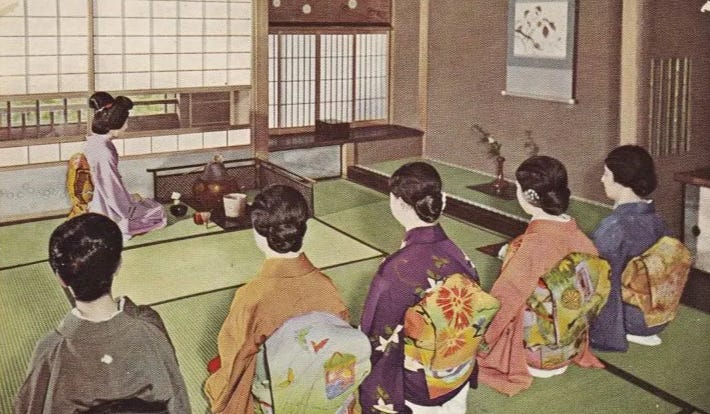
Tea ceremony, and by extension matcha consumption, would teach this generation about their own culture. And there is perhaps no living art more richly and specifically Japanese than chanoyu, as it both touches and supports a web of other crafts and industries: ceramics, incense, lacquerware, kaiseki cuisine, flower arrangement, garden design, architecture, ironwork, textiles, bamboo carving, among many others. The idea was that young Japanese girls would be trained in these traditional arts, enculturating them in their own heritage and equipping them to pass it on to their children.
To this day, the vast majority of tea ceremony practitioners in Japan are upper- to middle-class women who learned chanoyu in their youth and returned to it after their children left the house. It was this generation of new practitioners that kept Uji matcha alive through the 20th century. Today, roughly two million strong, they remain one of the most important domestic consumer bases for the matcha industry.
But even with this institutional support, matcha remained marginal in the broader tea market. From the Meiji restoration through the 1980’s there was significantly more gyokuro produced than matcha. [2] Even in 1980, matcha amounted to 389 tons out of Japan’s 100,000-ton tea output. [15] For nearly the entire modern era, the product that now drives a global export boom was a rounding error.
Meanwhile, the tea industry moved on. Japan’s Meiji export boom was driven by sencha and bancha, not matcha. A 1954 geographic study by Ukita Noriyoshi documented what had been happening for decades: production was physically shifting away from Uji proper to surrounding mountain areas, while Uji city maintained its position as the commercial and blending center. [12] The pattern that defines “Uji Matcha” today, where tea grown elsewhere is processed and sold under the Uji name, was already well established by mid-century.
What changed the calculus was mechanization. In 1912, the first electrically operated matcha stone mill was invented. But the real breakthrough came in 1924, when Horii Chojiro of the Horii Shichimeien tea house completed the “Horii-style tencha dryer” after years of painstaking effort. [6, 7] Before this invention, tencha processing required artisanal hand-drying skills guarded within Uji families. Horii’s machine used a combination of radiant and convection heat that produced uniform, high-quality tencha in a fraction of the time. And he did not monopolize it. He taught the technique freely to other producers. Most tencha processing machines in Japan today trace their roots back to the Horii-style kiln.
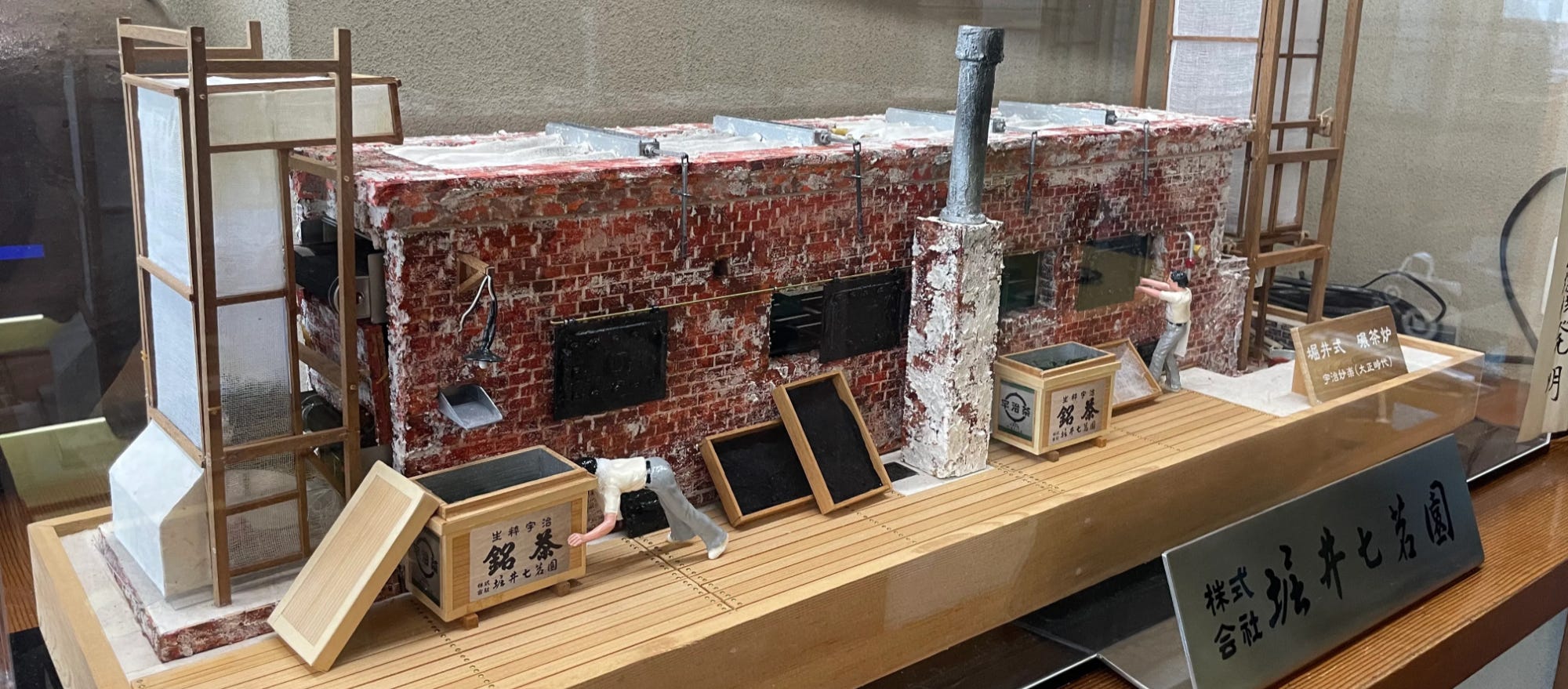
The Horii kiln made geographic dispersal possible for the first time. But for fifty years, almost nobody needed it to. All of Kyoto’s tencha was still hand-picked, the market was limited to tea ceremony, and the old production zone had more than enough capacity. [13]
Kuwabara Hideki, a fourth-generation Uji matcha wholesaler whose family has been in the tea trade since the Edo period, documented the production landscape of that era. In 1975, two years after he took over the family business, Uji produced 54 tons of tencha. Joyo produced 24. Yawata produced 17. And Wazuka, the mountain town that today produces roughly 41% of Kyoto’s tencha, produced nothing at all. [13]
Then came the ice cream.
In 1996, Haagen-Dazs launched Green Tea ice cream in Japan. [9, 10] It outsold vanilla two-to-one. Kuwabara, who was at the Kyoto tea auctions that spring, watched the market transform in real time. A single buyer, acting on a massive Haagen-Dazs order, bid 2,000 to 3,000 yen above the going rate on every lot, pushing prices to 150% of the previous year. Tencha that had sold for 5,000 yen per kilo was suddenly going for 7,000. The industry still calls it the Haagen Shock (ハーゲンショック). [14]
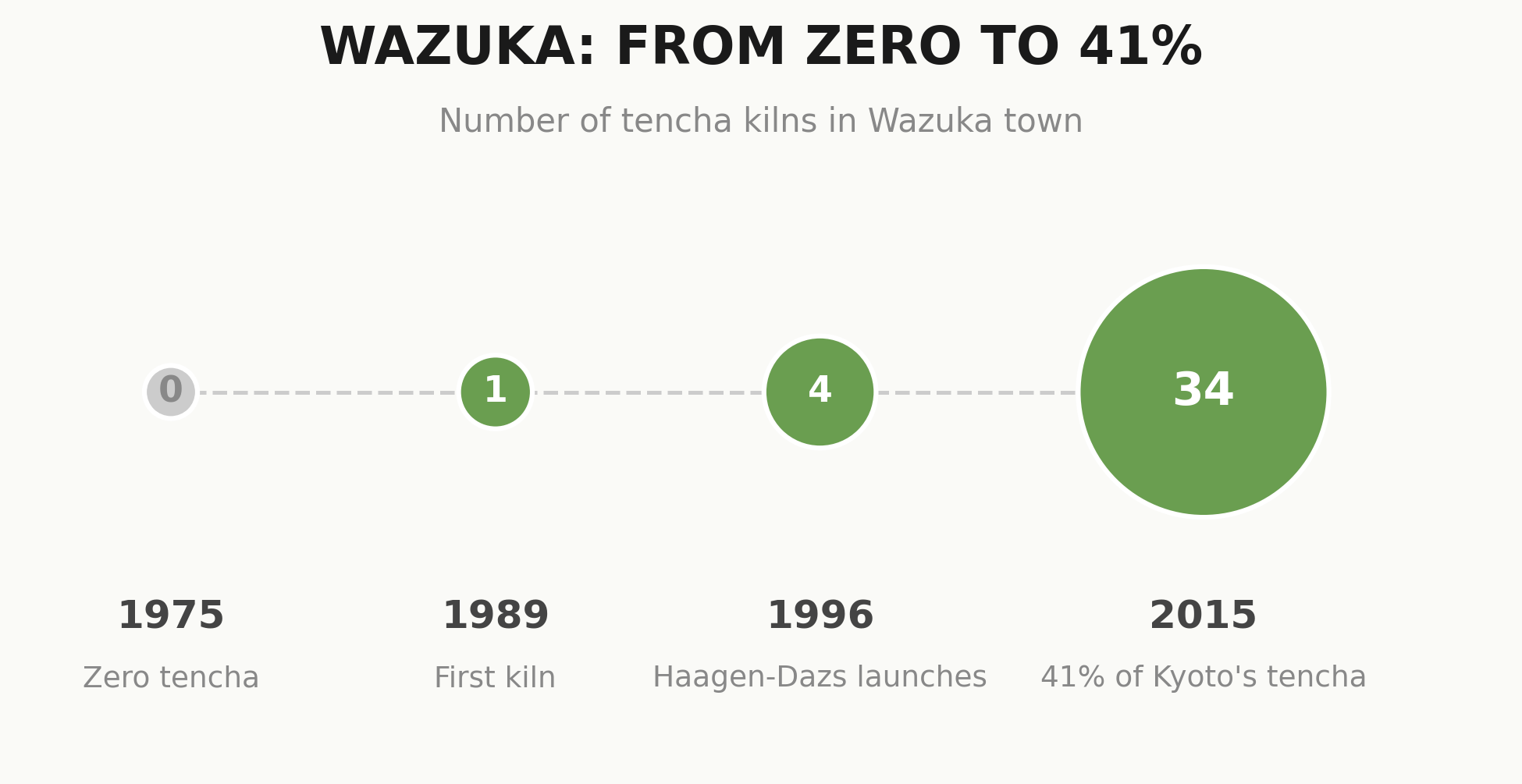
Wazuka’s tencha kilns went from 1 (in 1989) to 4 (by 1996) to 34 (by 2015). An entire town’s matcha industry was built in a single generation, driven not by centuries of terroir but by consumer demand for matcha-flavored ice cream. Kuwabara himself identifies one of the key reasons Wazuka succeeded: “宇治抹茶として売れること” or “it can be sold as Uji Matcha”. [13] Wazuka didn’t unlock some dormant potential in its hillsides. It retooled when the market made it profitable, and the Uji label made it possible.
Sources, Part 2
Paul Varley and George Elison, “The Culture of Tea,” in Warlords, Artists, and Commoners: Japan in the Sixteenth Century (University Press of Hawaii, 1981), pp. 187-222.
Robert Hellyer, A Bowl for a Coin: The Commodity World of Japanese Tea (University of Hawai’i Press). Table 4: Tea Production by Type 1884-1980, from Oishi Sadao, Chagyo hattatsu shi, p. 132.
Teramoto Yasuhide, “The Reevaluation of the Cultural Value of Japanese Green Tea: Uji-cha,” Keizaigaku Ronshu, Vol. 68, No. 3. English abstract.
Uji City Cultural Landscape Report (16217_16874_misc), Chapter 3: Hideyoshi’s vermillion seal banning non-Uji tea names.
Uji City Historical Museum, Kambayashi Shunmatsu Family Documents (Shuzo Bunsho Chosa Hokokusho 6), Document #1389.
David L. Howell, “How Green Was My Night Soil,” Ohio State University, 2012. bpb-us-w2.wpmucdn.com/u.osu.edu/dist/a/49661/files/2017/08/Howell-How-Green-Was-My-Night-Soil-OSU-Oct-2012-2j81g65.pdf
Seicha Tsujiki official site: Tsuji Kiyoharu, only living recipient of the Emperor’s Award (Tennohai) for tencha. Prime Minister’s Award (2017), Minister of Agriculture Award (x6). tsujiki.jp/about-en/
Specialty Matcha Podcast (hosted by Ryan and Zongjun): interview and field visit with Tsuji Kiyoharu, Seicha Tsujiki, Uji Shirakawa. open.spotify.com/episode/0Y2kn4w250fazxWNjVY9D8
Kristin Surak, Making Tea, Making Japan: Cultural Nationalism in Practice (Stanford University Press, 2013).
Rebecca Corbett, Cultivating Femininity: Women and Tea Culture in Edo and Meiji Japan (University of Hawai’i Press, 2018).
Tealife, “Export of Japanese Tea” (Market Data). japanesetea.sg/japanese-tea-pedia/marketdata/export-japan/
Ukita Noriyoshi (1954), “A Geographical Study of the Uji Tea Industry,” Shirin Vol. 37(4), pp. 385-399. Kyoto University. hdl.handle.net/2433/249136
Kuwabara Zensuke Shoten, “History of Matcha” Part 1-2: Tencha Production by Region. zkuwabara.com/mattya1_2.html
UNESCO World Heritage Committee Research Agenda (Shiryo 4-2): “They utilized processing and blending techniques to produce diverse, high-quality tea, firmly establishing the Uji tea name.”
Kuwabara Zensuke Shoten, All About Matcha, Part 6: "The History of Matcha, Part 4" and "Matcha and Culture" Part 1-2: Tencha Production by Region https://zkuwabara.com/mattya6_1.html