


Introduction
You pick up a tin labeled “Single Origin Uji Matcha.” You whisk it. You drink it. And if you’re anything like me, you spend a moment convinced you’re tasting a place. A valley. A river. Generations of skill rooted in one specific patch of earth south of Kyoto.
That’s what I believed for years. Each over-heaping scoop carried the taste of the land, tradition, care, and legacy. As if drinking this matcha allows you to tap into something larger than yourself. And honestly, that’s a beautiful thing to believe.
My cohost Zongjun and I started documenting our learning journey on the Specialty Matcha Podcast, interviewing industry experts, traveling to origin, and getting lost in research quests that went deeper than we intended. A different story started to unfold. The further we went, the larger the definition of “Uji Matcha” became. What we discovered was that “Uji Matcha” holds multiple identities: it’s an origin, a processing style, a trademark, and an idea that lives in the minds of everyday people who drink matcha. And those identities don’t always agree with each other.
This is the story of how Uji matcha slowly detached from its geography, became a brand large enough to contain four prefectures, and in the process, ended up mythologizing all the wrong things about what makes great matcha great.
So What Is Uji Matcha, Really?
Let’s start with the most basic question: what does “Uji Matcha” actually mean? Ask any consumer and you’ll probably hear something like “matcha from Uji.” And why wouldn’t they? The name is self-descriptive. It implies an origin. Many vendors spend paragraphs talking about Uji’s pristine landscape, its legendary terroir, and the generations of skill keeping the tradition alive. Consumers are primed to believe they’ve found a single origin product with unique and distinctive flavors from what is often crowned as the “ultimate terroir” for growing matcha.
But the legal definition tells a different story. According to the Japan Patent Office’s Regional Collective Trademark registration #6226519: [1]
“Uji Matcha is made from tea produced in four prefectures: Kyoto, Nara, Shiga and Mie, which is processed by a Kyoto company using a method originating from the Uji region, and then crushed and ground into a fine powder.”
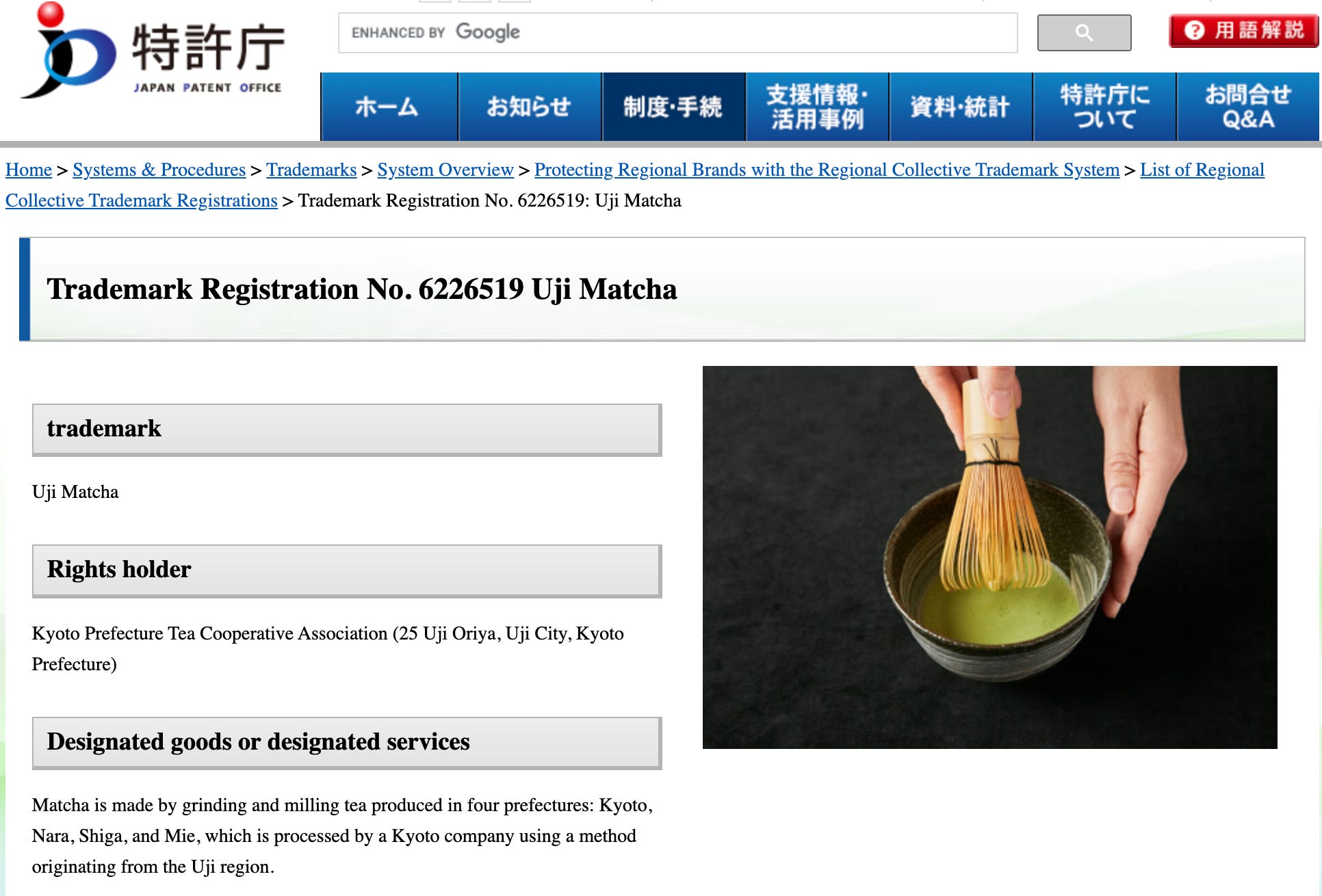
Nowhere in that definition does it say the tea must be grown in Uji. By definition, you could have 100% Mie-grown leaves processed anywhere in Kyoto prefecture using the “Uji method” and legally sell it as Uji Matcha. That’s not a loophole. That’s the design.
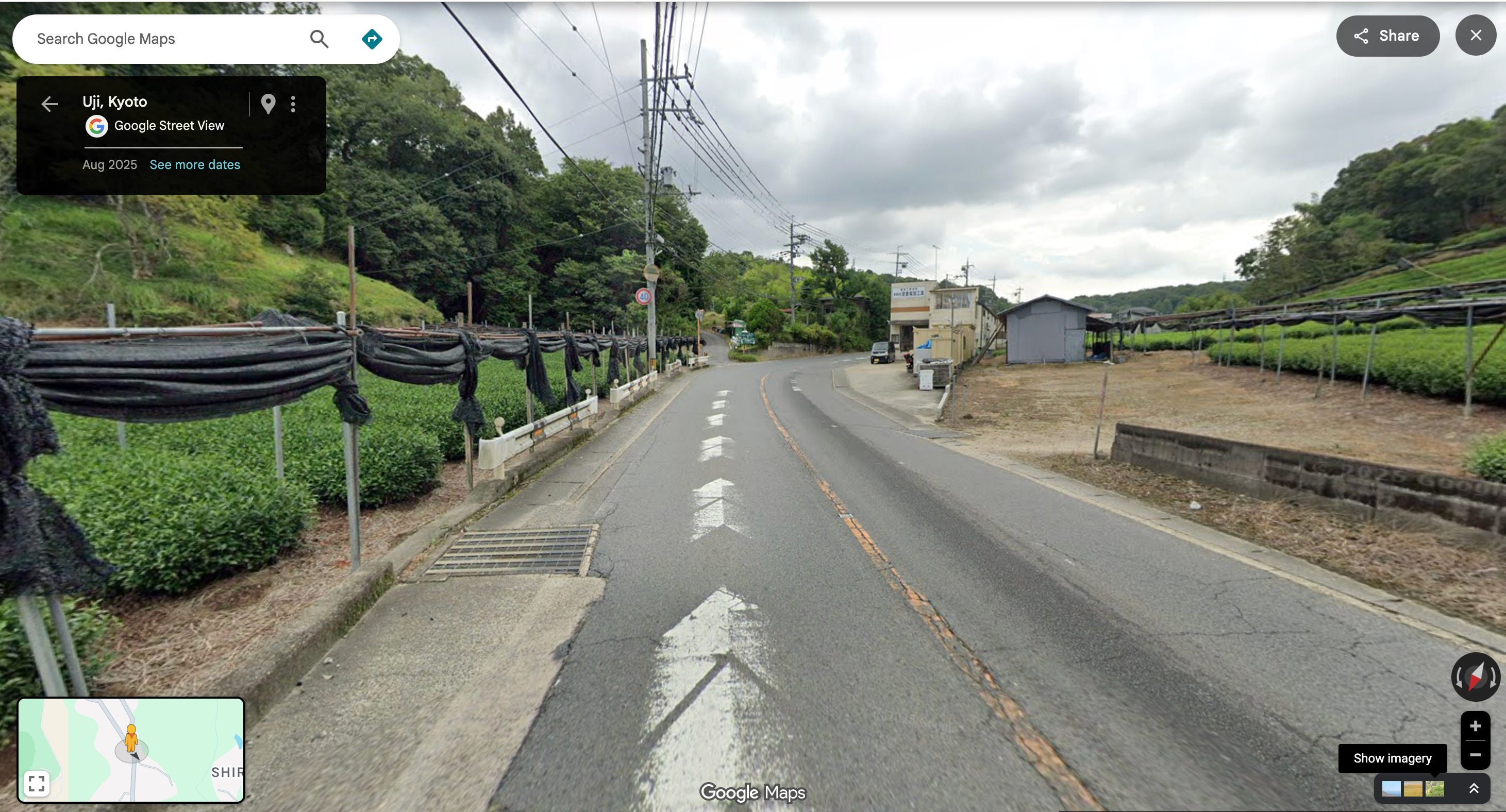
Uji City itself is incredibly small, and shocking urban place heralded as the cradle of the best matcha production and terroir. Tucked between highways, roads, and residential homes, Uji’s tea-growing land mass is even smaller. Although accounts vary, it’s estimated that there are only 35 families who are actively tea farming in Uji itself.
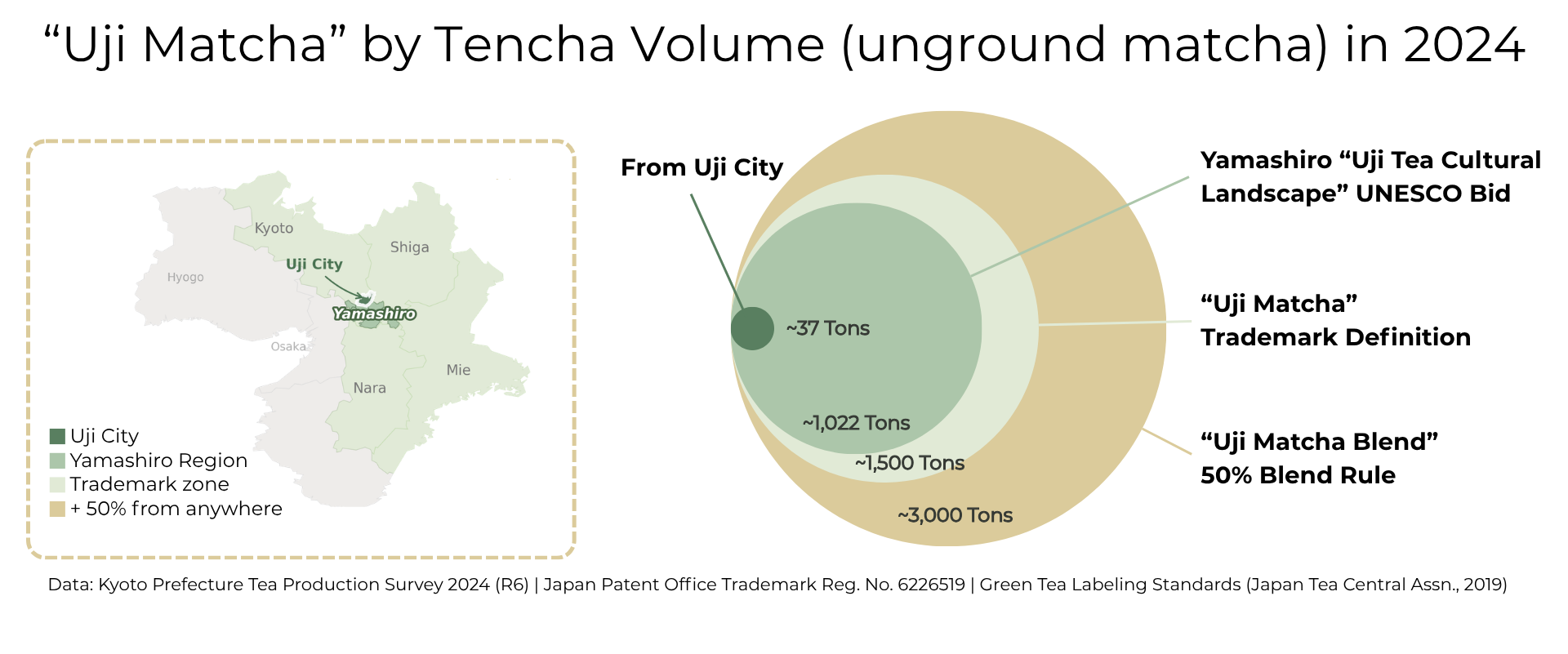
According to Kyoto Prefecture’s 2024 agricultural report, Uji proper has 77.8 hectares of tea fields, which represents 5% of Kyoto’s total tea acreage. [2] By production volume it’s even smaller: 37.6 tons of tencha (unground matcha) compared with 1,057 tons across the prefecture. That’s 3.6% of Kyoto’s tencha production. The four “Uji Matcha” trademark prefectures in total produced at least 1,500 tons of tencha combined. [3]
And then there’s the blend rule. Under Japan’s tea labeling standards, a product only needs to contain 50% tea from the four-prefecture zone to qualify as an “Uji Matcha blend.” [4] That means the other half can come from anywhere in Japan. This doesn’t just widen the definition; it roughly doubles the theoretical pool of raw material eligible to carry the “Uji” name to around 3,000 tons. That’s the ceiling, not actual production, but it gives you a sense of how far the label stretches beyond anything resembling a single origin.
True single origin Uji matcha from Uji-grown tencha represents 1-2% by volume of what can be legally labeled and sold as “Uji Matcha” or an “Uji Matcha Blend” (37.6t / 3000t = 1.25%). In reality it’s far less as most Uji matcha farmers sell the majority of their tencha to wholesalers which gets blended with tea from other regions.
The fraction that remains as a truly single origin product is probably less than 1% of Uji matcha sold.
Sources, Part 1
Japan Patent Office, Regional Collective Trademark Registration #6226519. https://www.jpo.go.jp/system/trademark/gaiyo/chidan/shoukai/ichiran/6226519.html
Kyoto Prefecture, 2024 Tea Production Survey (R6). https://www.pref.kyoto.jp/nosan/documents/r6chachosa2.pdf
Mie Prefecture Agricultural Statistics, 2023 Tencha Production. https://www.pref.mie.lg.jp/NOUSAN/HP/77019045892.htm
Japan Tea Label Standards: Origin Blend Requirements. lnews.jp/backnumber/2004/01/11158.html
A good reminder of the differences in criteria for labelling claims in other countries. Having been to Uji, it is rather small like you said. If tea leaves only came from Uji, I imagine the supply just wouldn’t keep up with demand.
Another great read! Looking forward to part 2