

Matcha's Predictability Crisis
Made-up grades, coin-flip cafés, and buyers who vanish.

Ask what makes a relationship work and people generally reach for big words. Trust. Honesty. Chemistry. But underneath all of those sits something quieter and more important: predictability. You can forgive a friend a bad day. What your friendship cannot survive is never knowing which version of them is going to walk through the door. Predictability is what lets you plan, invest, and relax. Without it, you hedge. You optimize for the next five minutes because the next five months are unknowable.
The matcha category has a predictability problem at every layer. It takes different shapes, but is quietly doing a lot of damage to the whole industry.
In the 1960s, Martin Seligman and Steven Maier ran their now-famous behavioral science experiments on dogs and aversive stimuli. The finding that became a cornerstone of psychology was not that suffering breaks an animal. It was that uncontrollable, unpredictable suffering breaks it in a way that consistent suffering does not. Dogs that could end a shock, or at least predict it, stayed more or less functional. Dogs subjected to shocks they could neither control nor anticipate stopped trying altogether, even later when escape was simple and available. They had learned that their actions and the outcome were unrelated. Psychologists named it learned helplessness, and it generalized: the passivity carried into completely new situations.
I am not comparing matcha drinkers to lab animals. But the mechanism is real and it scales to markets. When effort and outcome stop correlating, when paying more or reading the label or buying the “better” tin does not reliably get you a better bowl, people stop trying to understand. They disengage. They default to the cheapest option, or they leave the category entirely.
Unpredictability does not just annoy a consumer. It teaches them that learning is pointless. That is the most expensive lesson a category can teach.
So let’s go layer by layer.
The Consumer
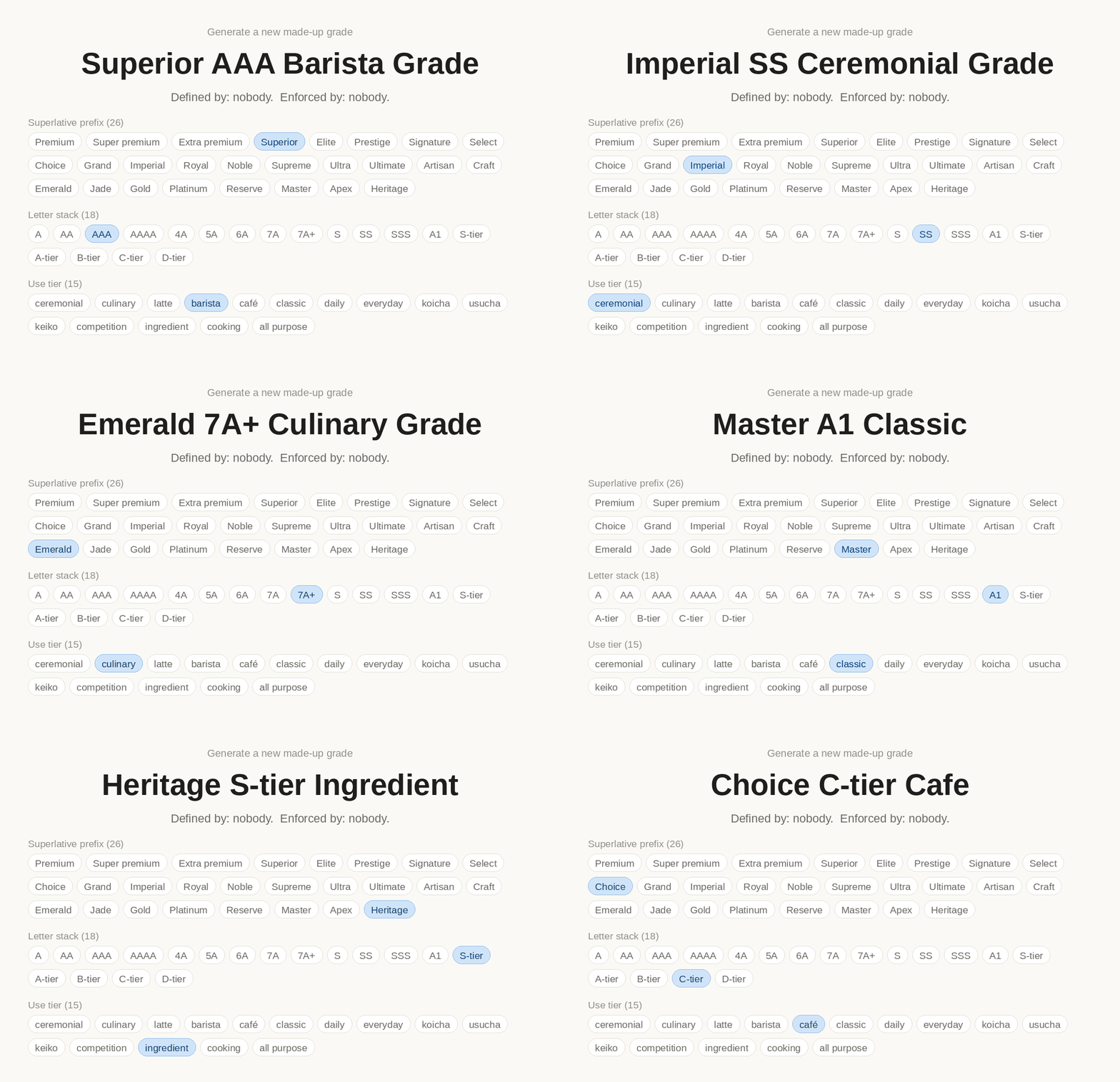
The consumer has been handed a grading system that is, to put it plainly, made up. “Ceremonial grade” is the headline offender. It has no grading body, no defining spec, no enforcement. It means whatever the seller wants it to mean. Brands are grading their own homework. Stack “ceremonial grade” on top of “Uji matcha” and “single origin,” each with its own definitional swamp, and multiply that by a few hundred companies all inventing their own vocabulary, and you have a system perfectly engineered to make effort feel futile.
Is it actually harder to say “first harvest” than “ceremonial grade”? First harvest is a real, verifiable, physically meaningful fact about the leaf. Ceremonial grade is a vibe. We invented an abstract term and abandoned the easier-to-verify one, because the vague term sells and the precise one commits you to something.
There is a fair counterargument, and it deserves room. Inside a single well-run brand, “ceremonial grade” is useful shorthand. If you trust the house, the word maps to a consistent internal tier. The problem is what happens when you zoom out. The moment a consumer tries to predict whether they’ll like something across brands, the term collapses. It is worse than worthless, because it looks like information while carrying none. It is the label-equivalent of a friend who says “trust me” right before letting you down.
Lead with ground truth instead. Harvest timing, cultivar, region you can actually defend, tencha oven, milling freshness, milling method. Metrics that are genuinely predictive of cup quality and that a buyer can use to learn something.
Give people a signal that rewards attention, and they will pay attention.
The Café
The experience of ordering a matcha latte at an unknown café feels like buying a lottery ticket. It’s expensive, the quality is extremely variable, and execution typically lives on the spectrum of “bad to worse.” In spite of this, matcha is still exploding. At Blank Street, matcha now accounts for roughly half of all orders, and on some summer days it outsells coffee outright.
A lot of this is not the café’s fault. The specialty coffee world arrived in matcha with real craft instincts and almost no reliable map. So they reached for “tradition,” which sounds like the safe bet. But traditional preparation is a deep body of knowledge that genuinely takes years to internalize, and you cannot shortcut it by importing a few ritual gestures and a chashaku. Half-understood tradition produces more variance, not less, and traditional workflow and equipment were never adapted to a high-volume café environment.
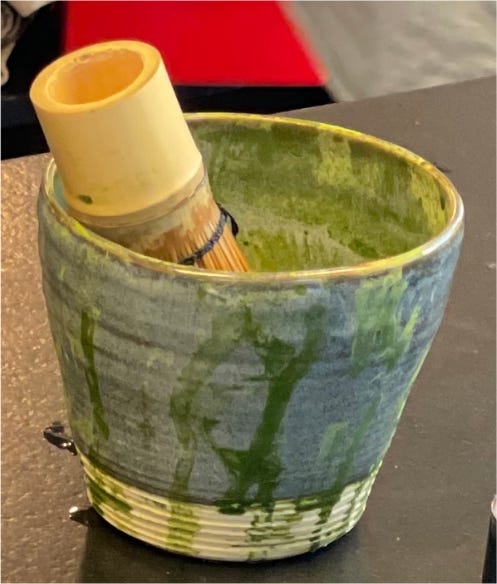
The better move for most cafés is to treat matcha with the same care that they would treat their coffee.
Develop procedures that are easily reproducible between baristas
Buy fresh ground matcha with a transparent mill date
Store it away from light, air, and humidity
Understand the provenance of the product you’re sourcing beyond “Japan”
The experience of ordering a matcha latte at a café is so bad that a lot of serious drinkers won’t even take the risk. Most everyday drinkers can genuinely make a better matcha drink themselves at home. Successful matcha programs are few and far between. The best cafés can confidently answer questions such as:
Where is your matcha from?
How many grams of matcha are in this beverage?
Is this a blend or a single cultivar?
These are questions that make ordering a matcha feel less like a gamble, and more like an informed decision that earned your vote with your dollars.
The Brand Owner
This is the layer where I’ve observed a pattern that holds true across four seasons of interviews on the Specialty Matcha Podcast, plus a lot of conversations we could never record. The single strongest predictor of a great matcha brand founder is not aesthetic taste, capital, or ability to craft a narrative. It is consistency. They show up season after season. They are reliable, repeatable buyers. They build a transaction history the way you build a credit score, one honored commitment at a time, until a farmer can plan around them.
After talking with a lot of producers and farmers in Japan, this is probably their number one concern of the “matcha boom” with regards to investment risk. Converting fields to tencha production is no small feat, tencha factories are extremely expensive, and starting a new field is an investment with a payback period on the order of a decade or more. Is the demand strong enough that all of these matcha brand owners are going to come back season after season reliably?
That is the whole game when it comes to sourcing, and it is the same psychology as a good friendship. A farmer cannot allocate their best leaf to a buyer who appears one strong season and vanishes the next. Predictability is the currency that buys you access to quality that money alone cannot. The founders who understand this are, in the most literal sense, being a good friend to their supply chain.
The Farmer
The farmer sits at the bottom of every chain above and absorbs the unpredictability of all of it. They make multi-year, sometimes multi-decade decisions: which cultivars to plant, how much tea to convert to tencha, whether to shade a field that won’t pay off for years. Those bets require exactly the thing the modern market refuses to give them, a believable read on future demand.
So consider what the boom actually did. A wave of buyers arrived chasing matcha as a trend, with no track record and for many no intention of staying if things get rough. For these brand owners it’s “easy in and easy out.” From the farmer’s seat that demand is hard to distinguish from noise. You cannot make a fifteen-year tencha decision on the strength of a TikTok. Not to mention that most farmers are past retirement age across the developed world and are not in the life stage for aggressive multi-decade investments.
The farmers who escape this are the ones lucky or deliberate enough to be tied to predictable buyers. Stable relationships let them make brave long-horizon choices, the kind that produce genuinely distinctive and interesting tea. Everyone upstream wants that distinctiveness. Almost nobody upstream offers the predictability that makes it possible.
Without the farmers nothing else matters, there is no matcha. If the industry is going to survive or even thrive this unprecedented level of global demand into the next generation’s “cup of coffee,” we need to create the conditions that incentivize farmers to make these risky bets: increase production and keep quality high. It all starts with predictability.
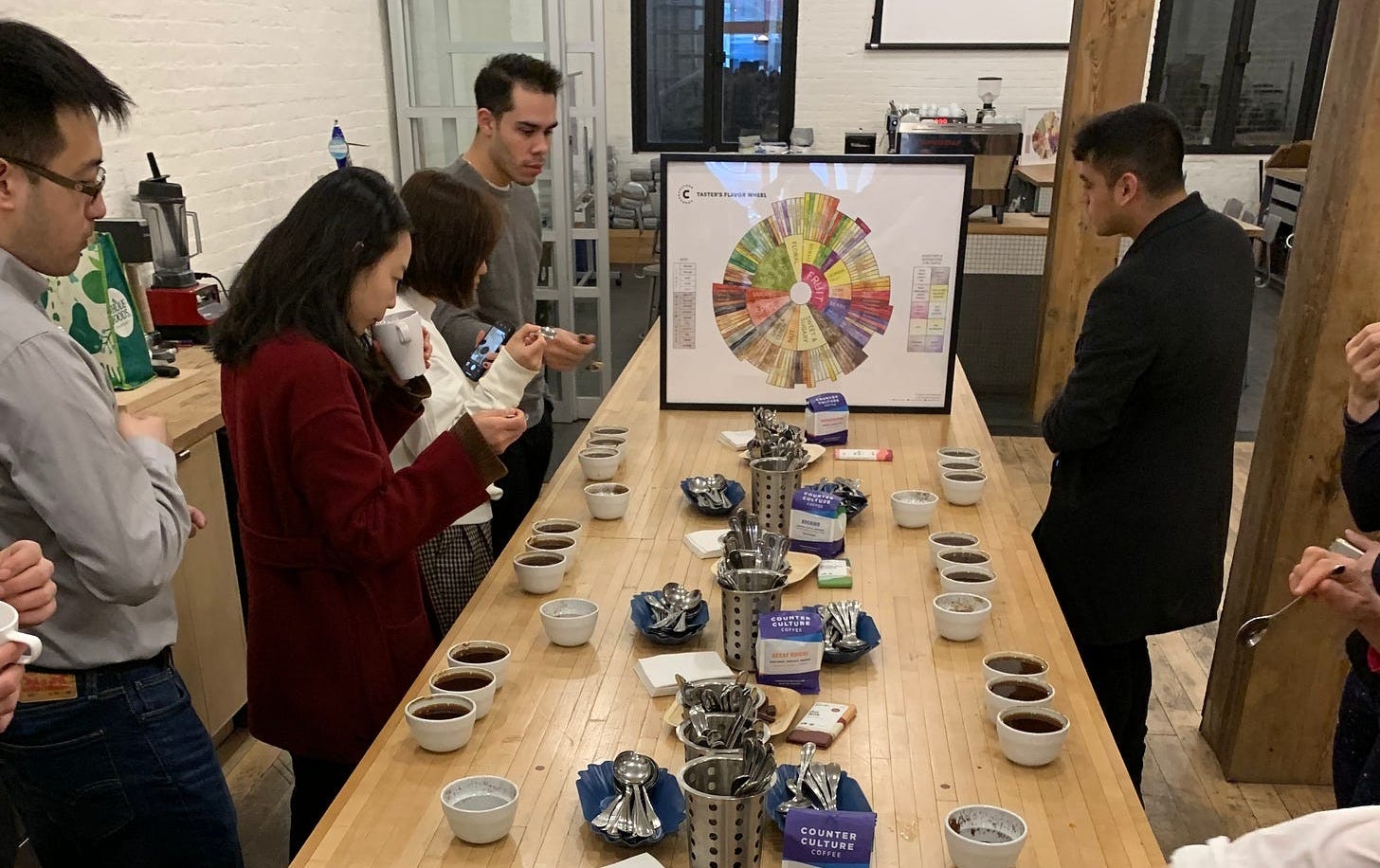
The specialty coffee industry sets a great example with many roasters committing to buy coffee even when quality is lower than previous years. When I lived in New York, I frequently participated in Counter Culture Coffee’s Tasting at Ten, a free educational public cupping. One of the lectures was about their commitment not to sourcing the best quality, but their commitment to being the best partner. They will over-pay for coffee, give feedback back to the producer to improve, and exercise their agency as a roaster to turn lemon into lemonade through roasting or blending.
The constant thread
Brands and cafés sit in the middle of this problem, with obligations running in both directions. Downstream, invented grades and cafés that cannot explain themselves teach the consumer that paying attention does not pay. Upstream, buyers who appear in a boom and vanish in a squeeze teach the farmer that planning ahead does not pay. Same lesson, pointed two ways: your effort and your outcome are not reliably connected, so hedge your bets and stop taking risks on this new and fledgling global matcha category. The consumer stops trying to learn or assumes they don’t like matcha enough to shell out $8 for a 50/50 shot at a good-tasting matcha latte. The farmer decides not to revive a neighbor’s abandoned plot or invest in better tencha processing equipment. Each of those decisions looks like apathy from the outside and feels like self-protection from the inside. It is the only rational response to an unpredictable industry, and it is a far cry from the conditions a specialty matcha revolution would need.
The fix is not romantic and it does not require a new mythology. Verifiable claims over invented grades. Repeatable preparation over performative tradition. Cafés that treat a matcha program with the same care as their coffee. Brands that honor commitments over brands that chase the green gold rush. Predictability is not the boring prerequisite to a great specialty matcha category. It is the great specialty matcha category.
Be predictable. Like a good friend.
My urasenke teacher buys matcha from a particular set of farmer each year for the last 30+ years. They give her everything she asks for even when there’s a “shortage” and other produces limit how much you can buy. She knows their quality and she gives feedback
It’s all about the relationship in Japan.
“You cannot make a fifteen-year tencha decision on the strength of a TikTok.” I got a good grin out of this one.
And if I may, a predictably solid post. 👏