


Tea laundering is a problem in Japan. It happens domestically, with material moving between prefectures and getting relabeled under a more famous name. It also happens with non-Japanese material blended into products labeled and exported as “Japanese.” Talk to tencha producers in China or South Korea, as my co-host Zongjun and I have done across four seasons of the Specialty Matcha Podcast, and many will proudly boast that their quality is so good, they “even export to Japan.” The matcha boom has put so much pressure on the system that producers are turning to regions outside Japan to secure raw materials. Japanese companies like Aiya and Kitagawa Hanbei Shoten are even making direct investments into Zhejiang and Hubei to expand production.
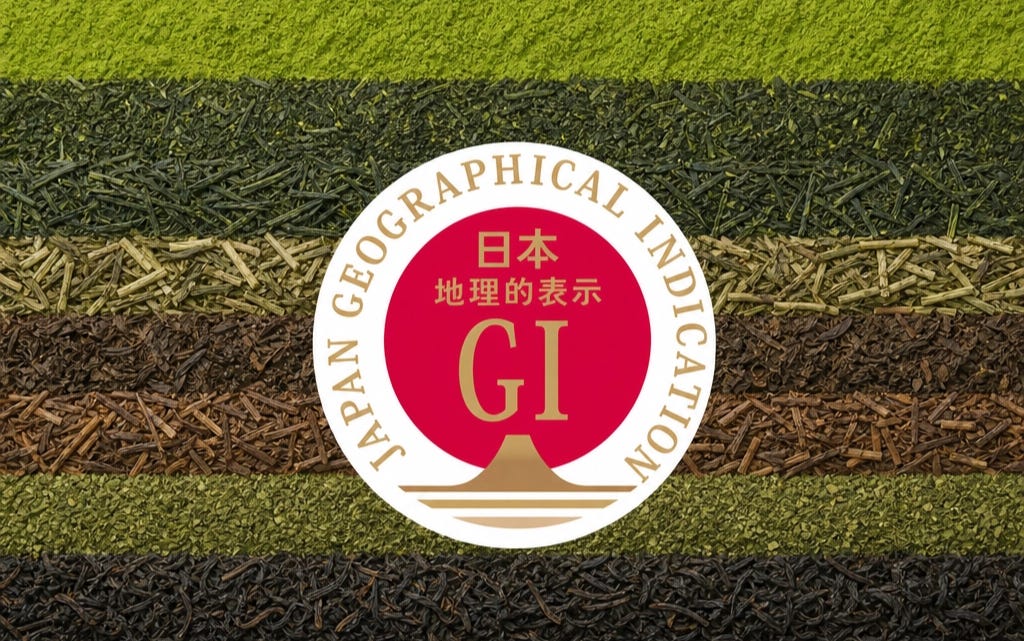
The news arrived May 4th, 2026 in the Nihon Nogyo Shimbun, in the agriculture section where trade news usually goes. Japan has filed an application to register “日本茶 (ニホンチャ, ニッポンチャ)”, “Nihon Cha”, “Nippon Cha”, “Japanese Tea”, and “Japan Tea” as a Geographical Indication under the country’s own GI Protection Act. The Japan Tea Industry Central Council filed in October last year and the application is now in MAFF’s expert review, having been formally publicly noticed in March. If it clears, the words “Japanese tea” become a protected legal designation in roughly the way Champagne and Parma are protected.
Read that again. Japan has filed to GI “Japanese tea.” The whole country, as one product, with one rule: it has to come from Japan.
That is a strange thing to file. GI was invented to protect specific places against generic imitation. Champagne is a region. Parma is a city. The point of the system is that protection tracks to specific producers in specific places using specific methods. There is no “French wine” GI (there is Vin De France but it’s not a GI). There is no “Italian cheese” GI. The few country-scope GIs that exist (Halloumi for Cyprus, Irish Whiskey for Ireland, Maltese sheep cheese for Malta) all cover a single specific product from a small country. There is no precedent for a major agricultural producer filing a GI on its entire national output for a whole category of products. Japan, if Nihoncha clears, will be the first.
The trade press is reading this filing as Japan stepping up to defend its tea. That isn’t wrong, exactly. But it skips a more interesting question, which is why a country would file something this broad in the first place.
What GI actually is
GI traces back to a French crisis. After phylloxera devastated French vineyards in the late 19th century, supply shortages drove a wave of fraud: producers blended cheaper wine, much of it imported from Algeria, and sold it under prestigious French regional names. The 1935 AOC system was the response, and France approached the problem region by region. Champagne defined Champagne. Châteauneuf-du-Pape defined Châteauneuf-du-Pape. The EU later generalized the framework into PDO and PGI in the early 1990s.
Crucially, GI is mutual and reciprocal. A registration only matters in countries that recognize it. Japan and the EU recognize each other’s GIs under a 2019 trade agreement; the UK has a parallel deal post-Brexit. Outside that web, the protection evaporates.
Feta is a great example. In 2002 the EU registered Feta as a Greek-only product. In 2005 the European Court of Justice confirmed it over Denmark’s objections. Danish, German, and French dairies that had been making “feta-style” cheese for decades were forced to relabel as “salad cheese” or invent new brand names. Outside the EU, generic feta labeling continues. American supermarkets still sell Wisconsin “feta.” The GI ends at the border.
What Japan is asking for is the right to do to “Japanese-style matcha” what the EU did to “feta-style cheese.” The leaf must be grown, aracha-processed, and finished in Japan. Anything else can no longer call itself Japanese tea on a European shelf, including products that previously blended Chinese or Korean leaf into a finished Japanese product. MAFF has run an active overseas monitoring program since 2024, and JETRO has coordinated foreign trademark enforcement for over two decades. Nihoncha would slot into that pipeline.
Where the GI will be effective
The GI does meaningful work where consumers actively read labels and care about origin. That’s the mid-tier specialty grocery shelf in EU and UK markets, the €30 to €40 tin sold to a buyer who isn’t paying for direct producer relationship but cares enough to read the small print. The mark will help that segment.
But the pyramid above and below that tier is mostly unaffected. The customer paying $60 for 30 grams of single-cultivar tea from Hoshino village in Yame at Setsugekka in New York, or 500 baht for a bowl of award-winning Ujihikari Usucha from Gokasho at MTCH in Bangkok, isn’t being deceived. They know the producer, often the cultivar, sometimes the harvest. The customer of the $12 tin of matcha on Amazon is a different problem: at that price, they probably care more about seeing “ceremonial” than “Japan”, because it’s going in their smoothie. And the United States, the largest single export market for Japanese tea, doesn’t recognize most foreign GIs anyway.
So the GI lands in the middle of the consumer pyramid, in EU and UK markets, on labeled tins. A real but narrow target.
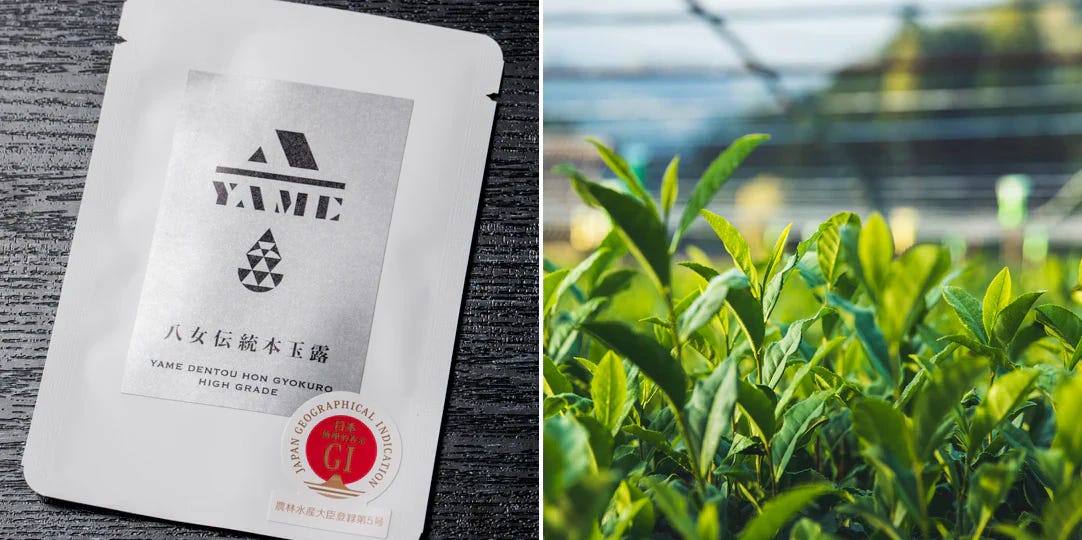
The existing track record on Japanese tea GIs makes the narrowness more concrete. Two have been registered. Yame Traditional Hon Gyokuro, GI No. 5, covers about 12 hectares out of Yame’s 1,510 hectares of tea acreage: under one percent, by a small group of producers using hand-picking, rice-straw shading, and traditional hand-rolling. Most of the gyokuro sold under the Yame name isn’t GI-certified at all. As a commercial category the GI is irrelevant, and it begs the question whether the rest of the “Yame Gyokuro” sold on the market is even strictly from Yame.
Nishio is the more revealing case. “Nishio no Matcha” was registered in 2017 and withdrawn in 2020 at the cooperative’s request. The GI’s traditional production rules pushed the output price to around 3,000 yen per kilogram in a market that wanted matcha at around 1,000. The cooperative chose distribution access over the mark. Nishio is also a name without a story outside the trade. There is no tea ceremony lineage there, no Sen no Rikyū, no famous masters whose names anchor the place. The GI mark protects against deception, and deception happens where reputation is worth stealing. (The longer version of this argument lives in Over-Mythologizing Matcha, the prior piece on this Substack.)
Yame’s strict GI is too narrow to move volume and Nishio was too restrictive for its actual market. Now Nihoncha proposes the opposite: a specification so broad that almost any domestic producer can qualify, and almost no consumer will be able to read meaning into.
What it’ll actually do
The most likely consequence isn’t on the European shelf. It’s a price pinch at the bottom of the market.
A meaningful portion of the roughly 5,801 tonnes of green tea Japan imported in FY2025, over 90 percent of it from China, has been getting blended into finished Japanese products and sold as Japanese tea, both domestically and abroad. That pathway is exactly what the GI restricts. The leaf isn’t going into the $60 tin at Setsugekka. It is going into PET bottle blends, supermarket tins, and mid-range matcha that competes on price. Cut the laundered supply out of the system and that segment, the price-sensitive bottom and lower-middle, is what gets squeezed.
The top of the market doesn’t notice. The middle pays a little more. The bottom pays a lot more, or migrates to alternative product. A category that has been quietly cushioned by Chinese supply for years has that cushion pulled, on top of an existing tencha shortage from the matcha boom, an aging farmer base, and conversion of other tea to tencha production. The classic regulatory irony: the people who care least about whether their matcha is “really Japanese” are the ones whose tins are about to cost more.
The other consequence is on the Chinese side, the displaced Chinese supply needs new markets.
This isn’t second-rate material. It’s arguable that non-Japanese matcha consumers care more about the made-up term “ceremonial grade” than “Japanese matcha.” It will be an easy and profitable marketing shift for this high-quality material to just be labeled and sold as premium “ceremonial grade” from China at 40% of the Japanese price. They could even use the fact that it was high enough quality to be used by Japanese tea masters as marketing material, and lean into their own identity as a matcha-producing region.
Cultivar choice gets pulled in the same direction. Many Chinese matcha producers currently use Japanese cultivars (Yabukita, Okumidori, among others) to chase the Japanese flavor profile. They now have a reason to pivot. Chinese cultivars like Fuding, normally used for Fujian white tea, or Longjing #43 from Hangzhou, produce distinctive flavor profiles when shaded and milled. The result, if Chinese producers take it, is more cultivar diversity globally and a more honest Chinese matcha category marketed on its own terms.
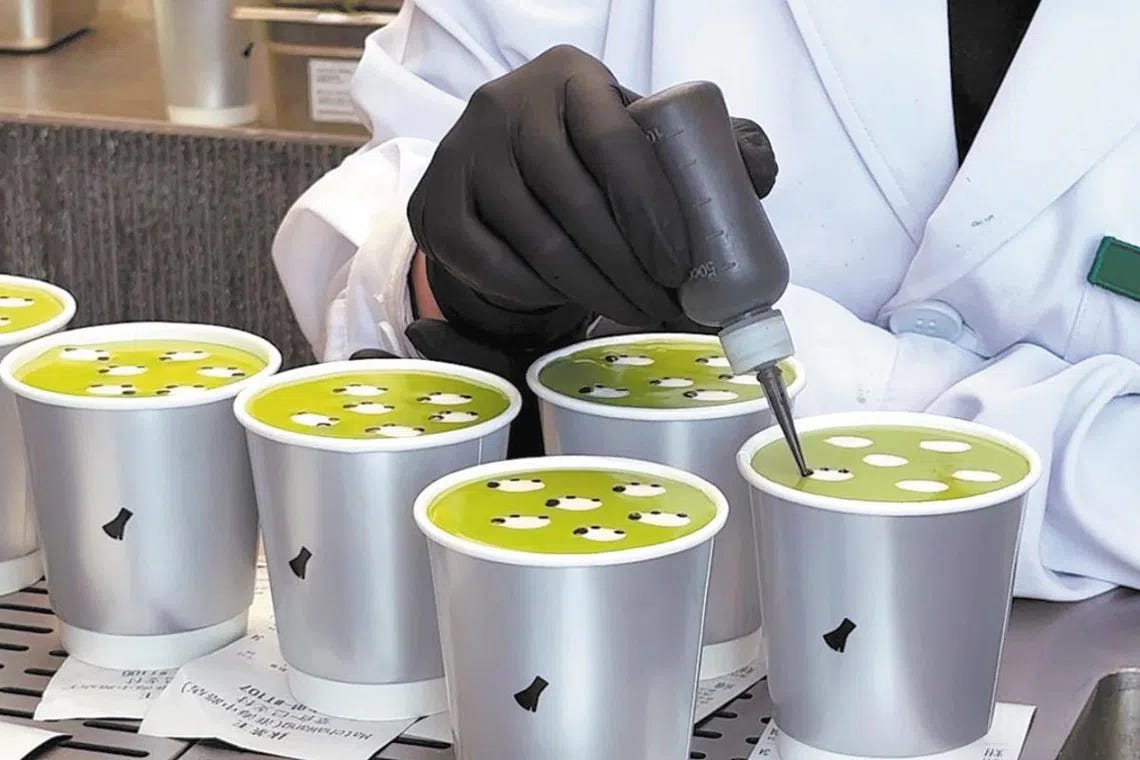
The viral vanilla bean matcha latte at Matcha Wang in Shanghai. PHOTO: CHINA DAILY/ASIA NEWS NETWORK
The filing is meant to protect Japan from imitation. What it might actually do is give China the push it needed to stop imitating in the first place.
Back to what GI actually means
GI is for a product, from a place. Champagne, from Champagne. Parma ham, from Parma. Feta, from Greece. The strongest possible Japanese tea GI would be Uji. Uji is what most consumers in Paris and Berlin and Singapore mean when they say they want “Japanese matcha.” Uji is the place name Chinese trademark courts have formally recognized as famous in Marukyu Koyamaen’s long fight against Chinese imitations.
Uji has no GI registration and probably never will.
Run the math. Uji City itself produces around 37 tons of tencha annually. In recent years, Japan has produced around 4,000 tons of matcha. Under the existing Uji-Cha trademark, tea grown in any of the four prefectures (Kyoto, Nara, Mie, Shiga) can legally be sold as “Uji Matcha,” and an “Uji Matcha blend” only needs half its contents from that zone. By volume, around 1,500 tons of tea per year can carry the Uji name; only 37 tons of that actually comes from Uji. So one in three tins of matcha made in Japan is sold under a name whose actual geographic origin makes up about two and a half percent of the labeled volume. And nobody in the industry agrees what Uji matcha even is in the first place: is it the four-prefecture trademark zone, the 50-percent-Kyoto-content blend rule, the geography being put forward in the Uji tea landscape UNESCO bid, or true single-origin tea from the city of Uji itself? Each of those definitions has industry constituents with economic reasons to defend it. The largest blend houses, the Kyoto prefectural authorities, the smaller specialty producers in Wazuka and Minamiyamashiro, and the city of Uji proper all want different things.
A GI requires a stable, enforceable specification. Uji has many mutually incompatible candidates. The single most globally recognized Japanese matcha region cannot file a GI on its own name. If it did, it would catapult the price of true Uji-grown tea (an incredibly scarce, finite resource) and leave everyone supplying the rest of the “Ujicha system” flat-footed. There is almost no demand or consumer awareness for the regions that actually supply the bulk of the Ujicha material.
Many people argue that Ujicha is more of an ecosystem of farmers, processors, and blenders than a place. And that’s true. Ujicha is largely a blended product, spiritually closer to a brand than a terroir. The industry has valued the secrecy and flexibility of blends, and the traditional market has valued consistency, not provenance. Those values do not cleanly map to the spirit of a GI.
You can argue that Japan spent too much time and money mythologizing the brand Ujicha. By current definition, it would never hold up to GI scrutiny since the material that actually comes from Uji is almost a rounding error against what’s sold as Ujicha. The processing doesn’t even need to happen in Uji or the Yamashiro “Uji” tea landscape region from the UNESCO bid, but anywhere in the entire prefecture of Kyoto under the existing trademark rules. The Japanese tea industry knows it needs to do something, but it has backed itself into a corner. The only thing it can do without killing the Ujicha golden goose is to protect the whole country. It’s a situationship the industry probably wishes it didn’t enter.
GI literally means geographic indicator. The strange part of this filing isn’t just that Japan picked the country instead of a region. It’s that Uji-cha by current definition is not actually geographically indicative of Uji. Nishio after the GI withdrawal is almost certainly sourcing material from outside Aichi and labeling it as a Nishio product. Until recently, a lot of “Shizuoka sencha” had Kagoshima leaf blended in and sold as Shizuoka cha. The Japanese tea industry has a tea laundering problem, and it isn’t only about Chinese material entering the supply chain. It’s about Japanese prefectures laundering to each other under names that consumers read as single-origin.
That is why Japan doesn’t have any commercially relevant tea GIs. The system doesn’t really respect provenance because the industry doesn’t, either. Until that gets honest, “Japan tea” really is the only indication Japan deserves.
The algebra of GI only works if two things are true at once. There has to be a region worth counterfeiting, and the label has to correspond to material from the place advertised. Japan has done a poor job with both, and this strange filing reflects it.
The more interesting future is one where Japan’s regional names earn their GIs: real consumer demand for product that actually comes from a particular place, enough mythology and economic value that someone has incentive to launder cheaper material in. That is exactly what GI is designed to protect against. Japan isn’t there yet. The Nihoncha filing is the half-measure of an industry that knows it.
That said, the GI is probably a net positive. It will be less impactful than most people will think, but at the Specialty Matcha Podcast, our reading is simple: anything that pushes the Japanese tea industry closer to verifiable provenance is a win.
To learn more about the complex question “what is uji matcha”, subscribe for our 5-part deep-dive series, Uji-no-Matcha: The inconvenient truth about Japan’s most mythologized tea label. Stay tuned.
This is definitely my takeaway, as it sounds like it was for William as well:
"The filing is meant to protect Japan from imitation. What it might actually do is give China the push it needed to stop imitating in the first place."
That's also a spin-off story I would love to read: how all of this is landing from a Chinese producer POV.
Also, just curious of these figures were correct from the Nishio section: "The GI’s traditional production rules pushed the output price to around 3,000 yen per kilogram in a market that wanted matcha at around 1,000."
It seems really cheap — 1,000 yen per kilo is like $6.
Great stuff SMP!
One thing I found interesting and perhaps concerning is that the GI application deliberately left out oxidized and fermented teas. Wakocha, Goishicha, and Awabancha producers will not be able to be called 'Japanese tea' if this gets approved.